World Marathon Majors: The Complete Guide
Everything you need to know about the six Abbott World Marathon Majors — from entry lotteries and qualifying times to course profiles, weather, and the Six Star Medal.
Table of Contents
What Are the World Marathon Majors?
The Abbott World Marathon Majors (WMM) is the most prestigious series in marathon running. It comprises six races held annually in some of the world’s greatest cities: Tokyo, Boston, London, Berlin, Chicago, and New York City. Together, they represent the pinnacle of the sport — drawing elite athletes chasing prize money and world records, and amateur runners pursuing the ultimate bucket-list challenge.
The series was founded in 2006 with five races. Tokyo was added as the sixth major in 2013. Each race has its own distinct character, entry process, and course profile, but they share a common thread: world-class organisation, massive crowds, and courses that pass through iconic landmarks.
For many runners, completing all six — and earning the coveted Six Star Medal — becomes a multi-year quest that spans continents and seasons.
The Six Majors at a Glance
| Race | City | Month | Elevation | Avg Temp | Profile | Entry Method |
|---|---|---|---|---|---|---|
| Tokyo Marathon | Tokyo, Japan | March | 42m | 10°C | Flat | Lottery |
| Boston Marathon | Boston, USA | April | 149m | 12°C | Hilly | Qualifying time |
| London Marathon | London, UK | April | 57m | 12°C | Flat | Ballot / Charity |
| Berlin Marathon | Berlin, Germany | September | 58m | 14°C | Flat | Lottery |
| Chicago Marathon | Chicago, USA | October | 137m | 15°C | Flat | Lottery |
| New York City Marathon | New York, USA | November | 250m | 10°C | Rolling | Lottery / 9+1 |
The combined elevation data tells a clear story: four of the six majors are flat courses (under 150m of elevation gain), making them suitable for fast times. New York is the outlier — with 250 metres of gain across five boroughs, it’s a rolling course where personal bests are rare but the experience is unmatched.
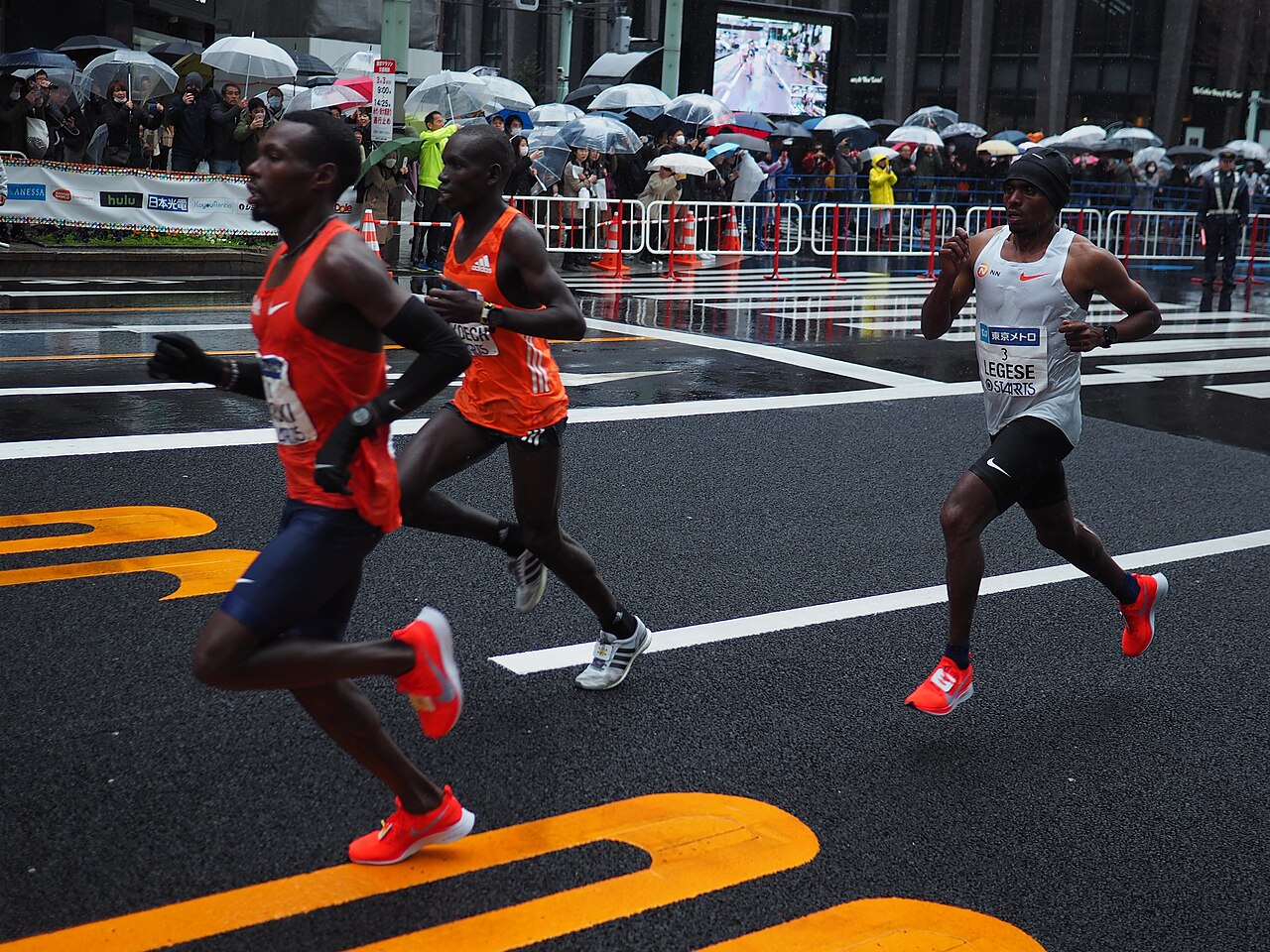
Tokyo Marathon — March
The Tokyo Marathon is the newest major and one of the most oversubscribed races in the world. The lottery acceptance rate is approximately 10%, making it the hardest major to enter by pure probability.
The Course
Starting at the Tokyo Metropolitan Government Building in Shinjuku, the course winds through the Imperial Palace, the neon-lit streets of Ginza, and the historic Asakusa district before finishing at Tokyo Station. With only 42 metres of elevation gain, it’s one of the flattest majors — gently descending for much of the route.
Weather and Conditions
March in Tokyo averages 10°C — excellent marathon conditions. Rain is possible but uncommon. The course is wide and well-organised, with aid stations every 2.5km offering water, sports drink, and Japanese snacks including rice balls and miso soup.
How to Enter
- Public lottery: Opens in August, results in October. Acceptance rate ~10%.
- Charity entries: Available through official charity partners with a fundraising minimum (typically ¥100,000 or ~$700).
- Tour operators: Several licensed tour packages guarantee entry with accommodation.
What Makes It Special
The Japanese spectator culture is unique — respectful, organised, and incredibly supportive. Aid station volunteers bow as you approach. The course passes through both ultra-modern and traditional Tokyo, and the post-race logistics (bag drop, medal, finisher t-shirt) are executed with Japanese precision. Many runners describe Tokyo as the best-organised marathon they’ve ever run.
Boston Marathon — April
The Boston Marathon stands alone among the majors — and among all marathons worldwide — as the only race that requires a qualifying time. Read our complete Boston qualifying guide for BQ standards and the best qualifying courses.
The Course
The point-to-point course from Hopkinton to Copley Square is 42.195km of history. The first half is predominantly downhill, dropping from 150m elevation to near sea level. Then come the Newton Hills between miles 17 and 21, including Heartbreak Hill — a series of four ascents that arrive exactly when your legs are most vulnerable. The final 5 miles are flat and fast into downtown Boston.
Total elevation gain is 149 metres with 286 metres of loss — net downhill, but the timing of the hills makes this one of the more challenging major courses.
Weather and Conditions
April in Boston is unpredictable. The average is 12°C, but historical race days have ranged from near-freezing rain to scorching 30°C heat. The 2018 edition was run in driving rain and 4°C temperatures; the 2012 edition hit 27°C. Prepare for anything.
How to Enter
- Qualifying time: Age-graded standards with a buffer of ~5–6 minutes below the published time.
- Charity entries: Available through official charity partners with fundraising commitments.
- Invitational entries: For elite athletes and special categories.
What Makes It Special
Boston is marathon running’s spiritual home. The Wellesley College “Scream Tunnel” at the halfway mark, the electricity of Kenmore Square, and the final stretch down Boylston Street deliver an atmosphere that no other marathon matches. Running Boston means you’ve earned your place — and every spectator knows it.
London Marathon — April
The London Marathon is one of the largest fundraising events in the world, raising over £1 billion for charity since its founding in 1981. It’s also one of the fastest courses on the majors circuit.
The Course
Starting in Greenwich near Blackheath, the course runs east through Canary Wharf before turning west along the Thames Embankment to the finish on The Mall in front of Buckingham Palace. With just 57 metres of elevation gain, it’s effectively flat — wide roads, smooth surfaces, and good sight lines throughout.
The iconic crossing of Tower Bridge at mile 12 is one of the great moments in marathon running. The roar of the crowd as you cross is something runners talk about for years.
Weather and Conditions
April in London averages 12°C with a meaningful chance of rain. Conditions are generally favourable for fast running, though the occasional warm year can push temperatures toward 18–20°C. Wind along the Thames Embankment can be a factor in the final miles.
How to Enter
- Public ballot: Opens in April/May, results in October. Acceptance rate ~10–15%.
- Championship entry: For runners meeting Good-for-Age qualifying times (faster than BQ standards).
- Charity places: The most common route — over 30,000 charity runners participate annually with fundraising minimums of £2,000+.
What Makes It Special
London combines world-class competition with carnival atmosphere. Fancy dress runners share the course with Olympic medallists. Crowd support is deep and sustained across the entire route — estimated at 750,000+ spectators. The charity culture gives the event a sense of purpose that extends far beyond personal achievement.
Berlin Marathon — September
The Berlin Marathon is the world’s fastest marathon course. The current men’s and women’s world records have both been set here, and it consistently produces the densest cluster of fast times of any race globally.
The Course
The loop course through central Berlin is spectacularly flat — just 58 metres of elevation gain across the entire distance. Wide boulevards, smooth asphalt, and gentle turns create near-perfect conditions for pace consistency. The course passes the Reichstag, Brandenburg Gate, and Potsdamer Platz, finishing with a dramatic run through the Brandenburg Gate.
Weather and Conditions
Late September in Berlin averages 14°C — slightly warm for optimal marathon performance but well within the comfort zone. Rain is possible. The course is exposed in places, and a headwind in the final kilometres along Straße des 17. Juni can challenge tired runners.
How to Enter
- Public lottery: Opens in October for the following year’s race. Acceptance rate varies but is typically 20–30%.
- Qualifying time: Fast runners can gain guaranteed entry through time-based qualification.
- Tour operators: Several guaranteed-entry packages are available.
What Makes It Special
Berlin is where records happen. The flat course, mild weather, and outstanding pacing teams create the perfect storm for fast running. If you’re chasing a marathon PB or a Boston qualifier, Berlin is statistically your best shot. The atmosphere is electric but controlled — German efficiency meets marathon passion. And finishing through the Brandenburg Gate is one of sport’s great dramatic moments.
Chicago Marathon — October
The Chicago Marathon takes runners through 29 distinct neighbourhoods in one of America’s great cities. It’s the second-largest marathon in the world by field size.
The Course
The course begins and ends in Grant Park along Lake Michigan. The loop passes through Chinatown, Pilsen, Little Italy, Greektown, and Lincoln Park, offering an extraordinary tour of Chicago’s cultural diversity. With 137 metres of elevation gain, it’s classified as flat — though it’s slightly more undulating than Berlin or London due to bridge crossings and overpasses.
Weather and Conditions
October in Chicago averages 15°C but the range is wide. Some years bring perfect 10°C conditions; others can hit 25°C or higher. Lake effect wind is the other variable — the stretch along Michigan Avenue can be exposed, and wind off the lake adds resistance in the final miles.
How to Enter
- Public lottery: Opens in late November, results in December. Acceptance rate ~30–40%.
- Time qualifier: Guaranteed entry for runners meeting age-graded time standards.
- Charity entries: Available through official charity partners.
What Makes It Special
Chicago’s neighbourhood diversity is unmatched. Each community brings its own flavour to the course — mariachi bands in Pilsen, taiko drums in Chinatown, gospel choirs on the South Side. The flat course and fall timing make it a strong PB course, and the city’s food culture means the post-race celebration is as good as it gets.
New York City Marathon — November
The New York City Marathon is the world’s largest marathon and, for many runners, the ultimate bucket-list race. Over 50,000 finishers cross the line in Central Park each year, supported by an estimated 2 million spectators.
The Course
This is the hardest of the six majors. The point-to-point course starts on Staten Island at the foot of the Verrazzano-Narrows Bridge and passes through all five NYC boroughs: Staten Island, Brooklyn, Queens, the Bronx, and Manhattan. Total elevation gain is 250 metres — the most of any major — with the Verrazzano Bridge climb at the start, the Queensboro Bridge at mile 15, and a series of rolling hills through the Bronx and Harlem.
The course is classified as rolling, and personal bests are less common here than at Berlin or Chicago. This is a race to experience, not necessarily to race for time.
Weather and Conditions
Early November in New York averages 10°C — cool and generally favourable. However, wind on the exposed bridges (especially the Verrazzano and Queensboro) can be brutal, and the course is open enough that weather is always a factor.
How to Enter
- Public lottery: Opens in January, results in March. Acceptance rate ~15–20%.
- 9+1 program: Complete 9 qualifying NYRR races plus 1 volunteer shift in the preceding year for guaranteed entry.
- Time qualifier: Age-graded standards for guaranteed entry.
- Charity entries: Available through Team for Kids and other partners.
What Makes It Special
Nothing compares to the energy of 2 million spectators lining 26.2 miles of New York City streets. The silence of the Queensboro Bridge followed by the wall of sound as you turn onto First Avenue is the most famous moment in marathon running. Central Park in autumn, the skyline views, the diversity of the boroughs — New York delivers an emotional experience that transcends the physical challenge.
The Six Star Medal
Complete all six World Marathon Majors and you earn the Abbott World Marathon Majors Six Star Medal — a single medal featuring a star for each race, symbolising one of marathon running’s greatest achievements.
How It Works
- Register your Six Star journey through the WMM app or website
- Complete all six races (in any order, over any timeframe — there’s no time limit)
- Results are verified automatically through race timing systems
- Your Six Star Medal is presented at the finish of your sixth major
The Numbers
Approximately 10,000 runners have earned the Six Star Medal since the program began. Given that each race has tens of thousands of finishers annually, the completion rate is remarkably low — the logistics of entering, travelling to, and completing six races across four countries and three continents take most runners 5–10 years.
Cost Estimate
A rough budget for the full Six Star journey:
| Expense | Estimate |
|---|---|
| Entry fees (6 races) | $600–$1,200 |
| Flights | $3,000–$8,000 |
| Accommodation (2–3 nights × 6) | $2,000–$6,000 |
| Ground transport, food, gear | $1,500–$3,000 |
| Total | $7,000–$18,000 |
The range depends heavily on where you live, how far in advance you book, and whether you’re staying in budget hotels or race-partner properties.
Planning Your Majors Journey
Recommended Order
There’s no required order, but strategic sequencing can help:
- Berlin first — fastest course, best PB opportunity, relatively easy lottery
- Chicago — strong fall option, good lottery odds
- London — enter the ballot early, consider charity entry
- Tokyo — hardest lottery, plan for 2–3 years of applications
- Boston — use your Berlin or Chicago PB to qualify
- New York — save the biggest spectacle for your Six Star finish
Training Across the Calendar
The majors span March to November, which means your training needs to adapt to different seasonal cycles. A solid 16-week training plan can be mapped to any of these windows:
| Race | Training Starts | Peak Training Season |
|---|---|---|
| Tokyo (March) | November | Winter |
| Boston (April) | December | Winter/Spring |
| London (April) | December | Winter/Spring |
| Berlin (September) | May | Summer |
| Chicago (October) | June | Summer |
| New York (November) | July | Summer/Fall |
Summer training for fall races (Berlin, Chicago, New York) means long runs in heat — start early in the morning, adjust pace for temperature, and review your nutrition strategy for hot-weather running.
Is It Worth It?
The Six Star journey is expensive, time-consuming, and logistically complex. It requires years of commitment, thousands of dollars, and the physical capacity to run 6+ marathons across different climates and courses.
But for runners who love the sport, it’s an extraordinary experience. Each race is a window into a different city and culture. The training gives structure and purpose across years. And crossing the line at your sixth major — wherever that may be — is a moment of genuine accomplishment.
The races aren’t going anywhere. Start with one, see how it feels, and let the journey unfold from there. Check our race-day preparation guide for everything you need to pack and plan before your first major.