Best Half Marathons for Your First Race
A comprehensive guide to the world's best beginner-friendly half marathons. Flat courses, generous time limits, and great crowd support — everything you need for your first 21.1km.
Table of Contents
The half marathon is the sweet spot of distance running. At 21.1 kilometers (13.1 miles), it’s long enough to feel like a genuine endurance achievement but short enough that most healthy adults can train for one in 10–12 weeks without restructuring their entire life. There are 129 half marathons in our database across six continents, and the best ones for beginners share a few key traits: flat courses, generous time limits, well-organized aid stations, and crowd support that carries you through the final kilometers when your legs start asking questions.
If you’re considering your first half marathon, this guide breaks down the best options worldwide — with real data on elevation, time limits, costs, and course profiles to help you choose the right race.
Why Start with a Half Marathon
Before we get to specific races, let’s address why the half marathon is the ideal first distance event.
The training is sustainable. A typical beginner half marathon plan runs 10–14 weeks with 3–4 runs per week, peaking at around 55–65 kilometers per week. Your longest training run tops out at 16–18 kilometers. Compare that to a marathon plan, which typically demands 16–20 weeks, 5–6 runs per week, and a long run peaking at 32–35 kilometers. The half marathon lets you experience structured training, tapering, and race-day logistics without the injury risk and life disruption of full marathon preparation.
You can walk portions and still finish. Most beginner-friendly half marathons set time limits of 3–3.5 hours, which works out to a pace of roughly 8:30–10:00 per kilometer. That’s a comfortable jog-walk pace. You don’t need to run the entire distance to cross the finish line and collect your medal.
The recovery is manageable. After a half marathon, most beginners feel sore for 2–4 days. After a full marathon, soreness can linger for 1–2 weeks, with full recovery taking a month. The half lets you celebrate and resume normal training much faster.
It’s a complete race experience. You get the expo, the early morning start, the crowds, the aid stations, the finish-line emotion — everything a marathon offers, compressed into a more accessible package.
What Makes a Half Marathon Beginner-Friendly
Not every half marathon is created equal for first-timers. Here’s what to look for:
Flat Course Profile
Elevation gain matters more than most beginners realize. A flat course with 0–50 meters of elevation gain lets you maintain a consistent pace without the energy cost of climbing. Hilly courses can add 10–20% to your finishing time. In our dataset, 8 of our recommended races have elevation gains under 100 meters, with Amsterdam Half Marathon sitting at a remarkable 0 meters of gain — the course is literally at sea level.
Generous Time Limits
A 3-hour time limit gives you plenty of buffer at beginner pace. A 3.5-hour limit is even better — it means you can sustain a 10:00/km pace (walking most of it) and still finish officially. Check our recommendations below for races with 3–3.5 hour limits.
Strong Organization and Aid Stations
Well-organized races have aid stations every 2.5–3 kilometers, clear course markings, pacing groups, and medical support throughout. Bigger races tend to have more resources, but even mid-sized events with a good reputation deliver excellent beginner experiences.
Crowd Support and Atmosphere
Running your first half marathon through empty industrial parks is a very different experience from running through city streets lined with cheering spectators. The races below all feature strong crowd atmospheres that provide genuine energy when you need it most.
Best Beginner Half Marathons by Region
Europe
Amsterdam Half Marathon
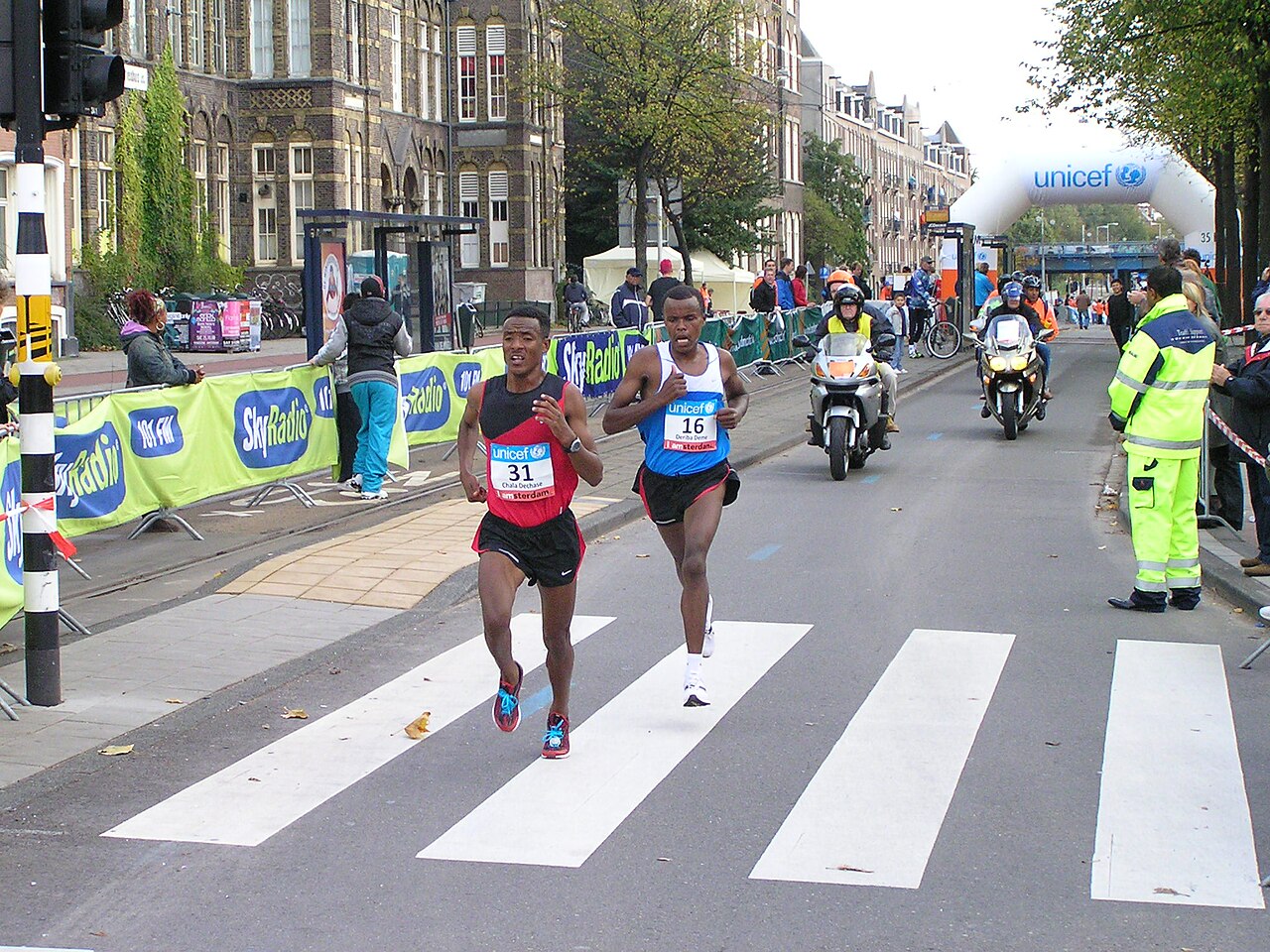
Why it’s great for beginners: The Amsterdam Half Marathon is one of the flattest half marathons on earth — zero meters of elevation gain on a loop course through Amsterdam’s historic canal district. At an average race-day temperature of 12°C in October, conditions are nearly perfect for distance running. The course passes iconic landmarks including the Rijksmuseum and Vondelpark, and the Dutch running culture creates a festive, supportive atmosphere.
- When: October
- Course: Flat loop, 0m elevation gain
- Time limit: 3 hours
- Entry fee: ~€80
- Difficulty: Easy
- Tags: Flat, fast, scenic, beginner-friendly
The October timing is ideal: you train through summer, building fitness as the weather warms, then race in cool autumn conditions. Amsterdam’s compact city layout means spectators line much of the course without needing to travel between viewing spots.
Barcelona Half Marathon
The Barcelona Half Marathon combines a fast, flat coastal route with February racing weather that averages 12°C. The course runs along the Mediterranean waterfront, offering sea views for much of the distance. With 95 meters of total elevation gain — negligible for a 21-kilometer course — your legs can focus on forward motion rather than climbing.
- When: February
- Course: Flat point-to-point, 95m elevation gain
- Time limit: 3 hours
- Entry fee: ~€70
- Difficulty: Easy
Barcelona’s February date is strategic for beginners in the Northern Hemisphere: it gives you a target during winter training, and the Spanish sun provides a welcome escape from darker, colder conditions back home.
Berlin Half Marathon
The Berlin Half Marathon runs through the German capital in April, passing the Brandenburg Gate, Reichstag, and Berlin Cathedral. The course features 85 meters of elevation gain — essentially flat — and April temperatures averaging 13°C make for comfortable racing conditions.
- When: April
- Course: Flat loop, 85m elevation gain
- Time limit: 3 hours
- Entry fee: ~€75
- Difficulty: Easy
Berlin’s running culture is world-class (the full Berlin Marathon is where most world records have been set), and that infrastructure extends to the half marathon. Expect excellent organization, well-stocked aid stations, and enthusiastic spectators throughout.
Madrid Half Marathon
The Madrid Half Marathon runs through the Spanish capital in April with a flat course (95 meters elevation gain) and a 3-hour time limit. Race-day temperatures average 16°C — slightly warmer than Berlin or Amsterdam, but still well within the ideal range for distance running.
- When: April
- Course: Flat urban, 95m elevation gain
- Time limit: 3 hours
- Entry fee: ~€55
- Difficulty: Easy
At €55, Madrid is one of the most affordable major European half marathons on this list. The course passes through Retiro Park and past the Royal Palace, combining urban scenery with green spaces.
Asia
Tokyo Half Marathon
The Tokyo Half Marathon is one of the most prestigious distance events in Asia. The flat, fast course (95 meters elevation gain) runs through central Tokyo in January, with average temperatures of 10°C — perfect racing weather. The organization is impeccably Japanese: every detail from bib pickup to finish-line logistics runs with precision.
- When: January
- Course: Flat point-to-point, 95m elevation gain
- Time limit: 3 hours
- Entry fee: ~€65
- Difficulty: Easy
Important note: The Tokyo Half Marathon fills via lottery, and the acceptance rate is competitive. Apply early and have a backup race in mind. If you get in, you’ll experience one of the most well-organized running events in the world.
Delhi Half Marathon
The Delhi Half Marathon is one of the largest and most affordable half marathons in the world. The flat course (85 meters elevation gain) runs through New Delhi’s historic center, and at ~€8 entry fee, it’s accessible to runners at any budget.
- When: October
- Course: Flat urban, 85m elevation gain
- Time limit: 3.5 hours
- Entry fee: ~€8
- Difficulty: Easy
Weather consideration: October in Delhi averages 28°C — significantly warmer than other races on this list. If you’re not accustomed to heat, this is a factor. The 3.5-hour time limit helps compensate, and aid stations are well-stocked with water and electrolytes. Start conservatively, walk aid stations, and use water to cool your neck and wrists.
Oceania
Sydney Half Marathon
The Sydney Half Marathon runs in July (winter in the Southern Hemisphere), with average temperatures of 18°C along a stunning coastal route through Sydney. The rolling course has 140 meters of elevation gain — more than the flat European options above, but the scenery and atmosphere more than compensate.
- When: July
- Course: Rolling point-to-point, 140m elevation gain
- Time limit: 3.5 hours
- Entry fee:
AUD 90 (€58) - Difficulty: Easy
Sydney’s 3.5-hour time limit is one of the most generous on this list, giving beginners ample room for walk breaks. The course offers views of the Sydney Harbour Bridge and Opera House — scenery that makes the kilometers feel shorter.
North America
Philadelphia Half Marathon
The Philadelphia Half Marathon runs in November through the historic city center, passing Independence Hall, the Art Museum (yes, the Rocky steps), and along the Schuylkill River. The flat course (95 meters elevation gain) and 10°C average temperature create ideal racing conditions.
- When: November
- Course: Flat loop, 95m elevation gain
- Time limit: 3.5 hours
- Entry fee:
$135 (€125) - Difficulty: Easy
Philadelphia’s November date works well for runners who use a spring-to-fall training arc. The 3.5-hour time limit is generous, and the crowd support along the course is strong — Philadelphians know how to cheer.
Training for Your First Half Marathon
The 12-Week Framework
Most beginner half marathon plans follow a similar structure:
Weeks 1–4 (Base Building): Run 3 times per week at easy, conversational pace. Weekly mileage: 15–25 kilometers. Longest run: 8–10 kilometers. The goal is building consistent habits, not speed.
Weeks 5–8 (Building Volume): Increase to 3–4 runs per week. Weekly mileage: 25–40 kilometers. Longest run: 12–16 kilometers. Add one “quality” session per week — either a tempo run (20 minutes at a comfortably hard pace) or intervals (4–6 × 800m with recovery jogs).
Weeks 9–10 (Peak): Highest training volume. Weekly mileage: 35–45 kilometers. Longest run: 16–18 kilometers. These are the hardest weeks. Trust the fatigue — it’s building fitness.
Weeks 11–12 (Taper): Reduce volume by 30–40%. Maintain intensity but cut distance. Longest run: 10–12 kilometers. You’ll feel restless and doubt your fitness. This is normal. The taper works.
Key Principles for Beginners
Run slower than you think you should. Your easy runs should be at a pace where you can hold a full conversation. If you’re gasping between sentences, slow down. Most beginners run their easy runs too fast, which increases injury risk and slows recovery.
Walk breaks are a strategy, not a failure. The run-walk method (e.g., run 5 minutes, walk 1 minute) is used by experienced runners and beginners alike. It reduces impact forces, manages heart rate, and often produces faster finishing times than continuous running at a slightly faster pace.
Prioritize consistency over heroics. Three 5-kilometer runs per week, every week, builds more fitness than one 15-kilometer run followed by a week of soreness-induced rest. Show up regularly.
Cross-train once per week. Cycling, swimming, or elliptical work builds aerobic fitness without the impact stress of running. One cross-training session per week reduces injury risk significantly.
Race Day Tips for First-Timers
The Night Before
Lay out everything: bib, shoes, socks, shorts, shirt, watch, gels (if using them). Check the forecast and adjust layers. Set two alarms. Eat a familiar dinner — nothing new, nothing spicy, nothing high-fiber. Aim for carbohydrate-rich: pasta, rice, bread.
Morning Of
Wake up at least 2.5 hours before your start time. Eat your practiced pre-run meal (toast with peanut butter and banana is a classic). Sip water but don’t overhydrate. Arrive at the venue 60–90 minutes early. Use the portable toilets early — the lines grow exponentially as start time approaches.
During the Race
Start slow. The most common beginner mistake is starting too fast, buoyed by adrenaline and crowd energy. Your first 5 kilometers should feel almost too easy. If you’re passing lots of people, you’re probably going too fast.
Walk every aid station. Trying to drink while running leads to half the water going down your shirt. Walk through the aid station, drink properly, then resume running.
Take in fuel. For efforts over 90 minutes, you need carbohydrate intake during the race. A gel at kilometer 8 and another at kilometer 15 is a common strategy. Practice this in training — never try new nutrition on race day.
Enjoy the last 2 kilometers. You’ve done the work. The finish line is close. Soak in the crowd, the music, the emotion. This is why you trained.
Choosing Your Race: A Decision Framework
If you’re still deciding between races, consider these factors in order:
-
Logistics: How easy is it to get there? A race that requires a 12-hour flight adds complexity and jet lag. Start local or choose a destination you’d want to visit anyway.
-
Weather: Check the average race-day temperature. The 7–15°C sweet spot produces the best beginner experiences. Above 20°C, heat management becomes a factor.
-
Course profile: Flat is your friend for race one. Save the hilly, scenic races for when you’ve got some experience.
-
Time limit: 3 hours is fine if you plan to run the whole way. 3.5 hours gives more room for walk breaks and unexpected slowdowns.
-
Budget: Entry fees range from €8 (Delhi) to €125 (Philadelphia). Factor in travel, accommodation, and a post-race celebration meal.
-
Calendar position: Pick a race that gives you 12–14 weeks of training time from today. Don’t rush the preparation.
The perfect first half marathon is the one you actually sign up for, train for, and finish. Every race on this list delivers a strong beginner experience. The differences are in scenery, budget, and logistics — not in quality. Pick one, register, start training, and discover what 21.1 kilometers of your own effort feels like.
What Comes After
Most first-time half marathoners finish with the same thought: “That was hard, but I want to do it again.” If that’s you, here are your options:
Run another half marathon. Now you have a baseline time. Pick a race 3–4 months out and train with a time goal. The jump from “finish” to “finish faster” is where many runners fall in love with the sport. Check our guide on first marathon preparation when you’re ready for the full distance.
Step up to the marathon. If the half felt comfortable and you finished strong, you might be ready for 42.2 kilometers. Check our marathon training plan guide for a structured 16-week approach, or browse our best marathons for beginners for races with the same beginner-friendly qualities listed here.
Explore destination racing. One of the best things about distance running is that it gives you a reason to travel. Our guides to the best fall marathons and best spring marathons cover seasonal options worldwide.
Whatever you choose, that first finish line changes something. It’s not about the time on the clock — it’s about knowing you can cover a distance that sounded impossible a few months ago. The half marathon is where that starts.