Best Marathons for Beginners
A data-driven guide to the world's most beginner-friendly marathons — flat courses, generous time limits, big crowds, and supportive atmospheres for first-time runners.
Table of Contents
What Makes a Marathon Beginner-Friendly?
Choosing the right race for your first marathon is one of the most consequential decisions you’ll make. A flat, well-supported course can turn your first 42.195 kilometres into a life-changing experience. A hilly, poorly organised, or intensely competitive race can make it miserable.
We analysed our database of 500 marathons and half-marathons worldwide and identified 219 marathons rated “easy” difficulty — meaning courses with manageable elevation profiles on well-maintained road surfaces. But difficulty rating alone doesn’t tell the full story. A truly beginner-friendly marathon combines several factors that work together to give first-timers the best possible experience.
Here’s what to look for, why each factor matters, and our curated list of the best first marathons in the world.
The Five Factors That Matter Most
1. Course Profile: Flat Is Your Friend
Elevation gain is the number one predictor of how tough a marathon will feel. For your first race, aim for courses with under 150 metres of total elevation gain. Our database shows 79 marathons with less than 100m of elevation gain — for a deep dive into the flattest options, see The Flattest Marathons in the World.
Why does flatness matter so much for beginners? Because hills force you to change your effort level constantly. On a flat course, you can find a comfortable rhythm early and hold it for hours. On a hilly course, you’re constantly accelerating and decelerating, which burns glycogen faster and fatigues your legs unevenly. As a first-timer, maintaining a consistent effort is your single most important pacing strategy.
2. Time Limits: Give Yourself Room
Many first-timers finish in 4.5–5.5 hours, and some take longer. There’s absolutely no shame in that — your first marathon is about finishing, not speed. Look for races with a time limit of at least 6 hours, and ideally 7 or more.
Be aware that even races with generous overall time limits may have intermediate cutoff points — checkpoint times you must hit to stay on the course. Check the race’s official page for details on intermediate cutoffs, especially if you’re planning to run-walk.
3. Field Size and Crowd Support
This is the factor most first-timers underestimate. Running a marathon is a lonely, gruelling experience if you’re doing it on a quiet rural road with 200 other runners. But running through a city with thousands of spectators cheering, bands playing, and fellow runners all around you? That energy is transformative.
Large city marathons — fields of 15,000 to 50,000+ runners — provide the densest crowd support. There’s always someone near your pace to run with. There are always spectators to lift you when you’re struggling. For your first marathon, this matters more than the scenery.
4. Race Organisation and Logistics
A well-organised race makes everything easier: clear signage, abundant aid stations (every 2–3 km), medical support, efficient gear check, good public transport to the start, and a well-managed finish area. Major city marathons almost always excel here because they’ve had decades to refine their operations.
Look for races with:
- Aid stations every 2.5–3 km with both water and sports drinks
- On-course medical support and physiotherapy stations
- Clear kilometre markers
- Pace groups with experienced pacers
- An expo/race pack collection that’s accessible the day before
5. Weather Conditions
Ideal marathon temperatures are 8–14°C — cool enough that your body can regulate heat efficiently, warm enough that you’re not shivering at the start. Avoid races where the average race-day temperature exceeds 20°C unless you’ve specifically trained in heat.
Humidity matters too. A 14°C race in dry continental Europe feels very different from a 14°C race in humid Southeast Asia. Check both temperature and humidity for your target race month.
Our Top 12 Marathons for Beginners
Tier 1: The Best of the Best
These races combine every beginner-friendly factor — flat courses, large fields, world-class organisation, great weather, and legendary crowd support.
1. Berlin Marathon
| Factor | Detail |
|---|---|
| Elevation Gain | 58m |
| Month | September |
| Difficulty | Easy |
| Field Size | 45,000+ |
| Why Beginners Love It | World’s fastest course, iconic Brandenburg Gate finish |
The Berlin Marathon is the gold standard. At 58 metres of elevation gain on a city loop through Berlin’s historic landmarks, the course is about as flat as a major city marathon gets. September weather in Berlin averages 14–18°C — right in the ideal zone. The crowd support is intense, with spectators lining virtually the entire route, and finishing through the Brandenburg Gate is an experience you’ll remember forever.
Berlin’s pace groups are well-organised with experienced pacers at every target time from 2:45 to 5:30. The aid stations are frequent and well-stocked. The only downside: it’s hugely popular and gets allocated by lottery, so you may need to apply early.
2. Chicago Marathon
| Factor | Detail |
|---|---|
| Elevation Gain | 137m |
| Month | October |
| Difficulty | Easy |
| Field Size | 45,000+ |
| Why Beginners Love It | 29 neighbourhoods, unrivalled crowd energy |
The Chicago Marathon winds through 29 distinct Chicago neighbourhoods, each bringing its own flavour of crowd support — mariachi bands in Pilsen, drum lines in Bronzeville, rock bands in Wrigleyville. The energy is relentless from start to finish.
At 137m of elevation gain, it’s not the absolute flattest course, but the elevation changes are so gradual they’re barely noticeable. October weather in Chicago typically delivers ideal 8–14°C conditions. The wide downtown streets mean zero congestion even with 45,000+ runners.
3. Valencia Marathon
| Factor | Detail |
|---|---|
| Elevation Gain | 47m |
| Month | December |
| Difficulty | Easy |
| Field Size | 30,000+ |
| Why Beginners Love It | Ultra-flat, perfect weather, rapidly growing reputation |
Valencia Marathon has quietly become one of the world’s best marathon experiences. At just 47m of elevation gain, the course is practically ruler-flat through Valencia’s modern City of Arts and Sciences complex. December weather averages 12–16°C — about as ideal as it gets anywhere in the world.
Valencia is also one of the most affordable major European marathons, with reasonable registration fees and lower accommodation costs than London, Berlin, or Paris. The running atmosphere in the city is genuine and enthusiastic. If you can only fly to one race, Valencia might be the best value in world marathon running.
Tier 2: Excellent Beginner Choices
These races are outstanding options with slight trade-offs that keep them from the very top tier.
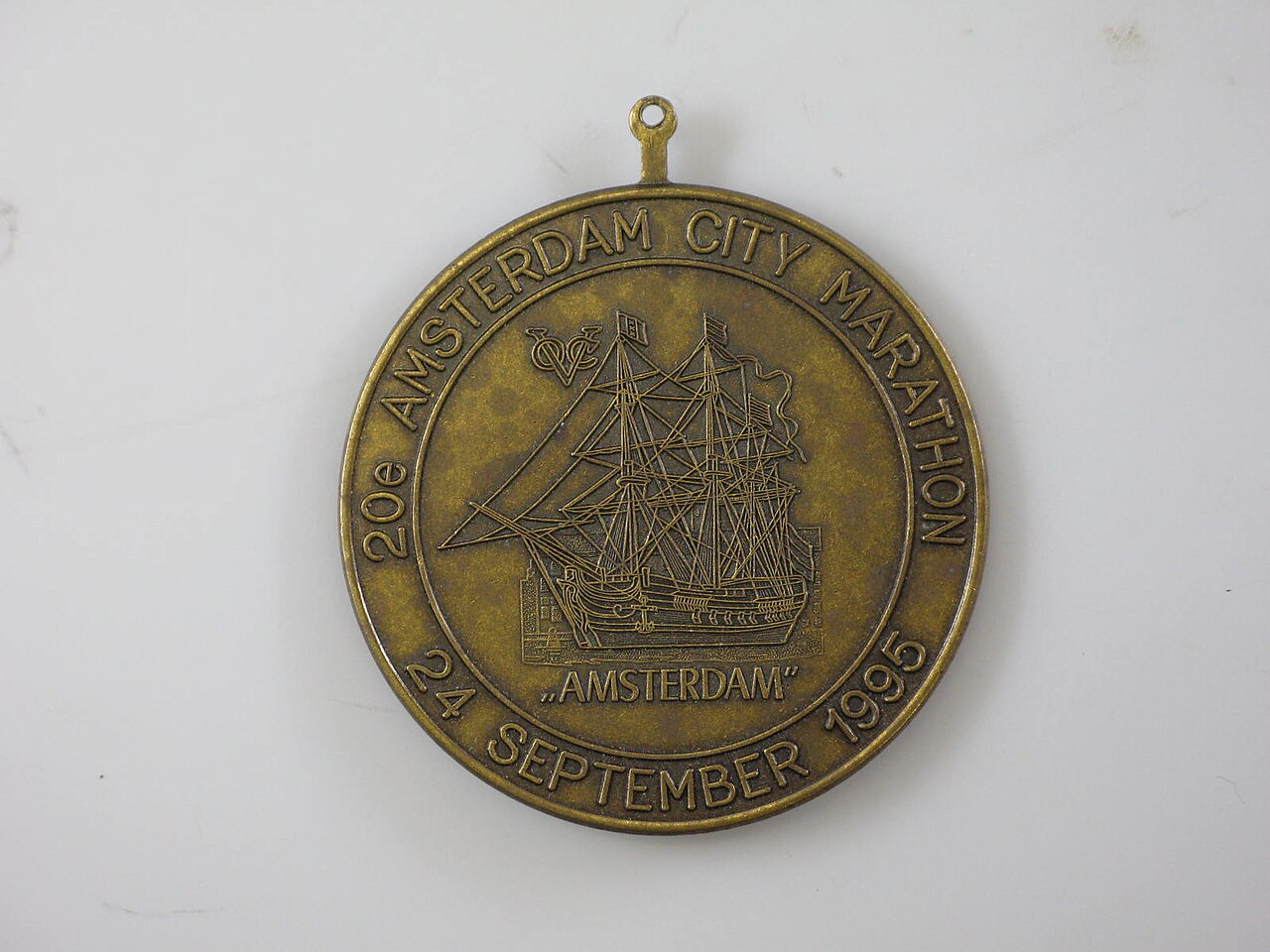
4. Amsterdam Marathon
| Factor | Detail |
|---|---|
| Elevation Gain | 22m |
| Month | October |
| Difficulty | Easy |
| Why Beginners Love It | One of Europe’s flattest courses, finishes in the Olympic Stadium |
At just 22 metres of elevation gain, the Amsterdam Marathon is one of the flattest courses on the planet — second only to the genuinely zero-elevation races. The course passes through Vondelpark and finishes inside the historic 1928 Olympic Stadium. October weather is typically cool and comfortable.
The Dutch know how to organise a race. Aid stations are frequent and well-stocked, and the flat Dutch landscape means you can see the course stretching ahead of you — psychologically reassuring when you’re deep into your first marathon.
5. Hamburg Marathon
| Factor | Detail |
|---|---|
| Elevation Gain | 85m |
| Month | April |
| Difficulty | Easy |
| Why Beginners Love It | Scenic spring course, excellent German organisation |
The Hamburg Marathon offers a beautiful spring marathon through one of Germany’s most vibrant cities. At 85m of elevation gain, the course is comfortably flat with only a few gentle rises along the Alster Lakes. April weather can be variable but typically delivers 8–14°C — ideal conditions.
Hamburg is a great choice for beginners who prefer a spring race (giving them winter to train) over autumn options. German races are famously well-organised with precise logistics.
6. London Marathon
| Factor | Detail |
|---|---|
| Elevation Gain | 57m |
| Month | April |
| Difficulty | Easy |
| Why Beginners Love It | 750,000+ spectators, iconic landmarks finish |
The London Marathon offers arguably the best crowd support of any marathon in the world, with an estimated 750,000+ spectators lining the course from Greenwich to The Mall. At 57m elevation gain, the course is flat, and the April timing usually provides cool racing conditions.
The challenge: London is allocated by ballot with roughly a 10% success rate. If you get a place, take it — the atmosphere is unmatchable. If you don’t, look at Berlin or Valencia as similar-quality alternatives.
Tier 3: Great Beginner Options with Character
These marathons are excellent for first-timers who want something a bit different from the classic European city marathon.
7. Walt Disney World Marathon
| Factor | Detail |
|---|---|
| Elevation Gain | 145m |
| Month | January |
| Difficulty | Easy |
| Why Beginners Love It | Runs through Disney theme parks, ultimate fun-first marathon |
The Walt Disney World Marathon is the marathon that doesn’t take itself too seriously — and that’s exactly what makes it perfect for beginners who are nervous about their first race. The course runs through all four Disney theme parks, with character photo opportunities, entertainment every kilometre, and a festive atmosphere that makes the distance feel less daunting.
At 145m of elevation gain, it’s not as flat as the European options, but the rises are gentle and spread over the full distance. The generous time limit accommodates run-walkers. January in Orlando means warm temperatures (15–22°C), so hydration planning is important.
8. Miami Marathon
| Factor | Detail |
|---|---|
| Elevation Gain | 0m |
| Month | January |
| Difficulty | Easy |
| Why Beginners Love It | Completely flat, scenic coastal course |
If eliminating elevation entirely is your priority, Miami Marathon delivers: zero metres of elevation gain on a course that crosses Biscayne Bay causeways and runs through Miami Beach and Coconut Grove. It is, along with Dubai and Venice, one of only three marathons in the world with literally no climbing.
The January timing means warm, humid conditions (18–24°C). If you’ve trained in heat, this is a dream course. If you’re coming from a cold northern climate, acclimatise for at least a week before race day. Read our Marathon Nutrition Guide for hot-weather fuelling strategies.
9. Detroit Marathon
| Factor | Detail |
|---|---|
| Elevation Gain | 142m |
| Month | October |
| Difficulty | Easy |
| Why Beginners Love It | Unique international course crossing into Canada |
The Detroit Marathon has a genuinely unique feature: you cross the Ambassador Bridge into Windsor, Ontario, run through Canada, and return to the US through the underwater Detroit-Windsor Tunnel. It’s the only marathon in the world where you run in two countries.
At 142m of elevation gain (mostly from the bridge crossing), the course is otherwise flat through Detroit’s revitalised downtown and along the riverfront. October weather is typically cool and comfortable. The international border crossing adds a memorable talking point to your first marathon story.
10. Tokyo Marathon
| Factor | Detail |
|---|---|
| Elevation Gain | 42m |
| Month | March |
| Difficulty | Easy |
| Why Beginners Love It | World Major, incredibly flat, impeccable organisation |
The Tokyo Marathon is one of the six World Marathon Majors and one of the flattest at just 42m of elevation gain — the course gently descends through central Tokyo. Japanese race organisation is meticulous: aid stations are precise, volunteer support is exceptional, and the course is impeccably clean.
The crowd atmosphere is unique — quieter than Western marathons but deeply respectful, with spectators bowing and offering individual encouragement. Many runners describe it as the most emotionally moving marathon experience available.
The challenge is entry: Tokyo uses a lottery system with low acceptance rates. But if you get a spot, it’s a bucket-list marathon that also happens to be extremely beginner-friendly.
11. Rotterdam Marathon
| Factor | Detail |
|---|---|
| Elevation Gain | 12m |
| Month | April |
| Difficulty | Easy |
| Why Beginners Love It | Second-flattest major marathon in the world |
At just 12 metres of elevation gain, Rotterdam Marathon is the second-flattest major marathon on Earth (behind the 0m trio of Dubai, Miami, and Venice). The course runs through Rotterdam’s modern architecture on wide, smooth roads. April weather averages 8–13°C — essentially perfect.
Rotterdam attracts a mix of competitive and recreational runners, so you’ll find pacing groups at every level. It’s an excellent choice for European beginners who want maximum flatness with reliable spring weather.
12. Cancún Marathon
| Factor | Detail |
|---|---|
| Elevation Gain | 15m |
| Month | December |
| Difficulty | Easy |
| Why Beginners Love It | Flat resort course, holiday-marathon combination |
The Cancún Marathon offers a flat 15m-elevation course along the hotel zone with Caribbean Sea views on both sides. December weather is warm but manageable (22–28°C). The field is smaller than the big-city marathons, which means a more relaxed, personal experience.
It’s the ideal choice for runners who want to combine their first marathon with a tropical holiday. The atmosphere is festive rather than competitive, and the post-race beach celebration is hard to beat.
How to Evaluate Any Marathon for Beginners
If the races above don’t fit your schedule or geography, here’s how to evaluate any marathon’s beginner-friendliness:
The Checklist
| Factor | Beginner-Friendly | Proceed with Caution | Avoid for First Marathon |
|---|---|---|---|
| Elevation gain | Under 150m | 150–300m | Over 300m |
| Time limit | 6+ hours | 5–6 hours | Under 5 hours |
| Field size | 10,000+ | 2,000–10,000 | Under 2,000 |
| Aid stations | Every 2–3 km | Every 3–5 km | Every 5+ km |
| Race-day temp | 8–14°C | 15–20°C | Over 20°C or under 5°C |
| Pace groups | Available | Limited | None |
Red Flags for First-Timers
- Trail or mixed-surface courses — Road running and trail running are different sports. Stick to road marathons for your first.
- Point-to-point courses with bus transfers — These add logistical stress on race morning. Loop or out-and-back courses are simpler.
- Races with qualifying time requirements — These are competitive events aimed at experienced runners.
- Ultra-small races — Under 500 runners means thin crowd support, few pacing groups, and potentially sparse aid stations.
- Extreme climate races — Desert, tropical, or high-altitude marathons add environmental stress on top of the physical challenge.
Planning Your First Marathon: A Timeline
12 Months Before
- Research and select your target race
- Register early (many popular marathons sell out or require lottery entry months in advance)
- Begin building a running base if you’re not already running regularly
6 Months Before
- Start a structured training plan (16–20 weeks out from race day)
- Book travel and accommodation if running a destination race
- Begin testing nutrition and hydration strategies
3 Months Before
- Your long runs should be reaching 25–30 km
- Finalise your race-day fuelling plan
- Study the course map and elevation profile
1 Month Before
- Peak mileage week, then begin tapering
- Confirm all logistics: race pack collection, start-line transport, post-race meetup
- Prepare your race-day kit: bib, shoes, gels, body glide, outfit
Race Week
- Carb-load for 3 days before (see our Marathon Nutrition Guide)
- Attend the expo and collect your race pack
- Rest, hydrate, and trust your training
For complete training advice, read our First Marathon Beginner’s Guide.
The Bottom Line
Your first marathon should be a celebration, not an ordeal. Choose a flat course, give yourself plenty of time, run where the crowds will carry you, and pick weather conditions that work in your favour.
The races on this list aren’t just beginner-friendly — they’re genuinely great marathons that experienced runners return to year after year. You’re not settling for an “easy” race. You’re choosing a course that lets you experience the marathon distance at its best.
Line up. Run your race. Cross the finish line. Everything else is gravy.